Sin by Fredriksen Paula
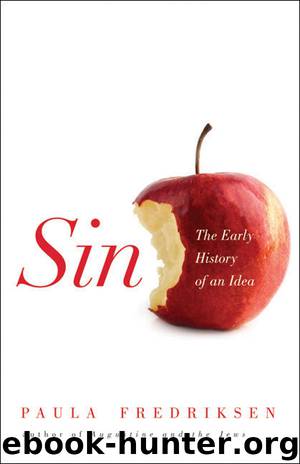
Author:Fredriksen, Paula
Language: eng
Format: epub
Publisher: Princeton University Press
Published: 2012-04-10T04:00:00+00:00
Origen died in Caesarea in 254, a belated victim of the Decian persecution. His language was Greek, his philosophical education superlative. He was comfortable with interpretive ambiguities, frequently proffering multiple opinions and inviting his hearers to choose whichever one struck them as more reasonable (e.g., III. vi, 9). He was also a charismatic lifelong celibate. (Indeed, so untroubled was his asceticism that two rumors arose to account for it, one that Origen’s serenity was achieved by drugs, the other, by the knife.) His circumstances and his temperament, in short, could not have been more different from Augustine’s.12
Born in North Africa in 354, well after Constantine had thrown the empire’s fortunes in with those of the church, Augustine had been a married man, the father of a son, and for more than ten years a Manichaean heretic. His secular career as a teacher of rhetoric ceded only eventually to his ecclesiastical one: baptized into the catholic church in 386, he became bishop of Hippo in 396. As a bishop, Augustine had political and institutional incentives to be clearer about doctrine—and certainly less speculative—than Origen had ever had to be: by Augustine’s day, doctrine translated into public policy, bishops were a species of Roman magistrate, and imperial agents clarified theological disputes by force. His first-order awareness of the sexual, social, and political dimensions of human life profoundly affected the ways that Augustine understands sin. He explored these most especially in his huge masterwork, City of God.13
Augustine, further, had never really learned Greek, a limitation of incalculable consequence. He read both testaments of his Bible only in (clumsy) Latin translation, a fact that colors his views on language and interpretation as indices of sin’s effects on the mind and the soul. And his knowledge both of pagan Greek philosophy and of the rich tradition of Greek patristic commentary, Origen’s included, was limited to what he could get in Latin translation. This linguistic-intellectual isolation in one sense handicapped him; but it also compelled and even amplified his own fierce creativity. We see this most clearly in his idiosyncratic masterpiece, the Confessions.14
Finally, Augustine came of age theologically in the late 390s/early 400s, just as the storm of the Origenist controversy burst upon—and blew apart—the pan-Mediterranean community of orthodox theologians. Theories of the soul’s preexistence seemed suddenly uncomfortably close to heresy: Western tradition increasingly leaned toward seeing soul and body as beginning life together at the same time. And as souls became ever more incarnate, so too did history: the meaningful arena of God’s activity shifted to events in this world. The faithful recited creeds asserting their belief in bodily, even fleshly resurrection. Hell’s eternal fires burned too attractively to be renounced. And nobody wanted Satan to be saved.15
Different man, different temperament, different times—and very different views, consequently, on divine justice and mercy, and on the meaning and consequences of sin. These were the premier issues framing Augustine’s life’s work, from his commentaries on Paul’s letter to the Romans against the Manichees in the 390s to his polemics against Pelagius and especially against Julian of Eclanum in the 420s.
Download
This site does not store any files on its server. We only index and link to content provided by other sites. Please contact the content providers to delete copyright contents if any and email us, we'll remove relevant links or contents immediately.
The Secret Power of Speaking God's Word by Joyce Meyer(3242)
Signature in the Cell: DNA and the Evidence for Intelligent Design by Stephen C. Meyer(3141)
Real Sex by Lauren F. Winner(3027)
The Holy Spirit by Billy Graham(2961)
The Gnostic Gospels by Pagels Elaine(2537)
Jesus by Paul Johnson(2366)
Devil, The by Almond Philip C(2339)
23:27 by H. L. Roberts(2255)
The Nativity by Geza Vermes(2234)
Chosen by God by R. C. Sproul(2168)
All Things New by John Eldredge(2167)
Angels of God: The Bible, the Church and the Heavenly Hosts by Mike Aquilina(1971)
The Return of the Gods by Erich von Daniken(1948)
Angels by Billy Graham(1929)
Knowing God by J.I. Packer(1861)
Jesus of Nazareth by Joseph Ratzinger(1816)
The Gnostic Gospel of St. Thomas by Tau Malachi(1802)
Evidence of the Afterlife by Jeffrey Long(1795)
How To Be Born Again by Billy Graham(1789)
